Image
Research
Research
Piezoelectric ceramics and single crystals have been extensively studied at the laboratory. Although LGEF activities have significantly evolved with the rise of electroactive polymers, the laboratory retains strong expertise in PZT-type materials (lead zirconate titanate), as well as lead-free materials such as BT (barium titanate), and their applications.
Lead-free ceramic materials.
In collaboration with the University of Sfax, several families of lead-free ferroelectric relaxor materials are being investigated for their piezoelectric and electrocaloric properties. The interest in such materials is twofold:
reduced environmental impact
phase transition temperatures close to room temperature, which can be tuned through composition
Direct effects measured by calorimetry are compared with values obtained through indirect methods based on polarization as a function of electric field and temperature. Ceramics with composition (Na₀.₅Bi₀.₅)₀.₉₄Ba₀.₀₆TiO₃ doped with rare-earth elements, for example, exhibit effects greater than 2 K under low electric-field excitation—values similar to or higher than those obtained in ferroelectric single crystals such as PMN-PT.
Other lead-free ceramics based on barium titanate doped with zirconium, tin, or calcium are also studied for their piezoelectric and electrocaloric properties..
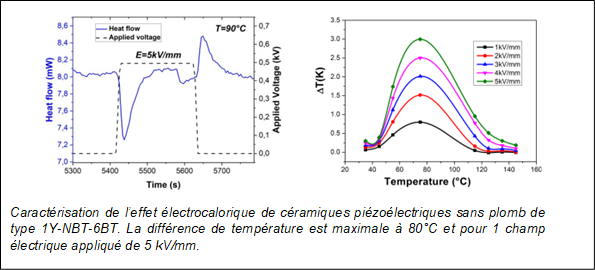
https://dx.doi.org/10.2139/ssrn.4011866
Hydrothermal synthesis of inorganic fillers.
To obtain controlled, high-quality inorganic fillers for the development of electroactive composites, the laboratory is capable of producing inorganic materials via hydrothermal synthesis. This process involves obtaining crystalline materials under high-temperature and high-pressure conditions in an aqueous solution. It enables the production of micrometric or nanometric materials with controlled morphologies.
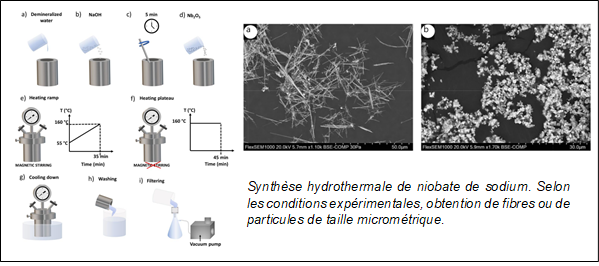
https://doi.org/10.1016/j.matdes.2022.111195